
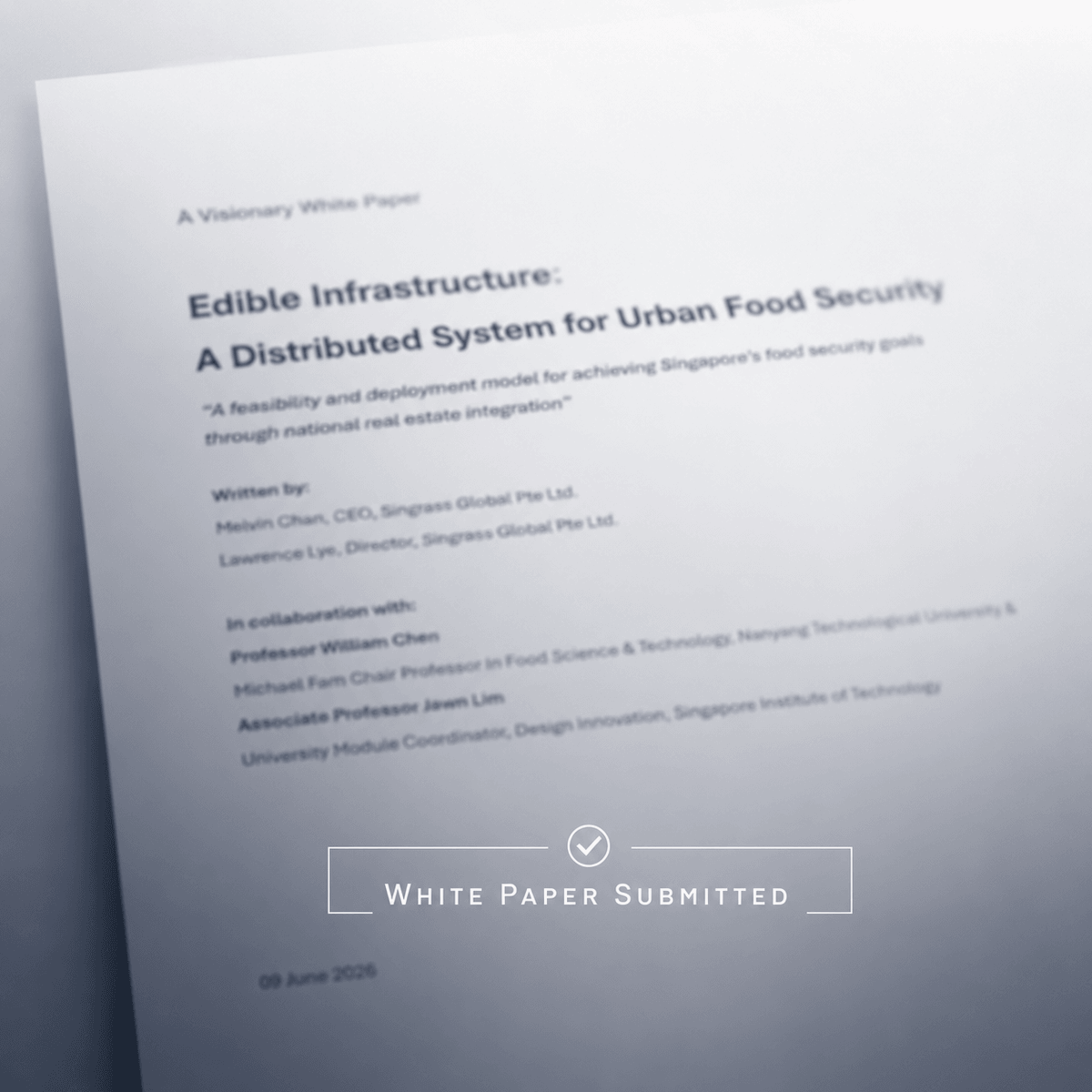
Singrass Global has submitted our white paper, “Edible Infrastructure: A Distributed System for Urban Food Security,” for policymakers’ consideration.
This paper was developed by Singrass Global in collaboration with NTU Professor William Chen and SIT Associate Professor Jawn Lim, and sets out a distributed food-production model integrated into homes, commercial buildings, and public-sector spaces.
In an increasingly turbulent world shaped by supply-chain disruption, geopolitical volatility, energy shocks, and climate stress, food security especially in the area of fresh vegetable nutrition is likely to be strengthened most effectively through locally distributed systems alongside current centralized production nodes and our diversified import sources.
At the heart of the paper is a simple but important idea: buildings can become part of the food system. Underutilised space across residential, commercial, and institutional environments can be reimagined as productive infrastructure that supports freshness, nutrition, indoor environmental quality, and supply-chain resilience.
At the same time, the challenge is not simply to identify unused space. The larger challenge is to make food-producing systems easy to deploy, scalable at speed, aesthetically pleasing, able to blend naturally into the built environment, simple to maintain, and acceptable to the wider population. Without these qualities, the concept remains interesting in theory but difficult to embed in everyday urban life.
That is why the paper focuses not only on production, but on system design, adoption, and integration into the rhythms of how people live, work, learn, and heal.
We hope this contributes meaningfully to ongoing conversations on Singapore’s food security, healthy buildings, and the future of urban infrastructure.
For those with a serious interest in the topic, we may share the full white paper on a case-by-case basis. Please feel free to reach out.